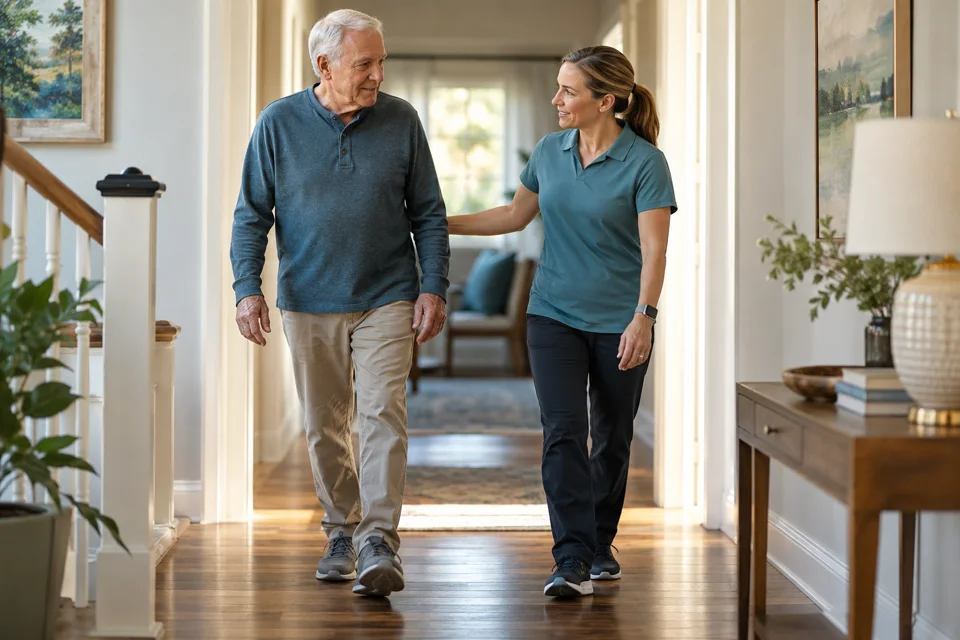
Parkinson’s can make starting a walk, turning in a doorway, getting out of a chair and maintaining activity more difficult. During a home visit, I look at where movement becomes challenging and choose practical goals with you and, when helpful, your caregiver.
Look at movement in your own space
I may assess step length, turning, balance, transfers, freezing and the support you use. We discuss falls, fatigue and whether movement changes across your medication schedule. I do not change medication; that information helps us plan activity and communicate with your medical team when needed.
Exercise is a core part of Parkinson’s rehabilitation
The APTA Parkinson disease clinical practice guideline supports aerobic exercise, resistance training, balance training, external cueing, gait training and task-specific practice when appropriately selected. The exact combination depends on the person. Physical therapy should challenge movement enough to be useful while accounting for safety, medical status and day-to-day response.
Use cueing for a reason
Visual, auditory or attentional cues can help some people with gait, freezing or movement amplitude. A cue that helps one person may distract another, so I assess the response rather than giving everyone the same strategy. We can practice the actual chair, hallway, doorway or threshold that matters to you.
Keep support and caregiver instruction part of care
A walker or other aid may be appropriate when walking is unsafe without support. We can review device setup, how assistance is provided and when a task should be supervised. Caregiver instruction focuses on strategies we have practiced rather than unfamiliar balance challenges.
Build activity beyond the therapy visit
Parkinson’s management benefits from regular physical activity, not only the minutes spent with a therapist. When appropriate, I help establish walking, aerobic, strengthening or mobility routines that can continue between visits and evolve over time.
Measure useful changes
Goals may include safer turns, easier chair rises, improved step length, more manageable community walking or a safer trip to the bathroom. Physical therapy supports function, activity and participation; it does not cure Parkinson’s or guarantee that falls will stop.
Research behind this article
The American Physical Therapy Association’s evidence-based clinical practice guideline for Parkinson disease supports multiple forms of exercise and movement training, including aerobic exercise, resistance exercise, balance training, external cueing and gait training. Selection and dosage should be individualized.
Discuss care at home with Dr. Lenny
I provide one-on-one physical therapy at home in Ivyland, Warminster and nearby communities. Call or text Dr. Lenny: 267-647-9097.
General education; your exercise plan and medical restrictions should be based on an individual assessment.