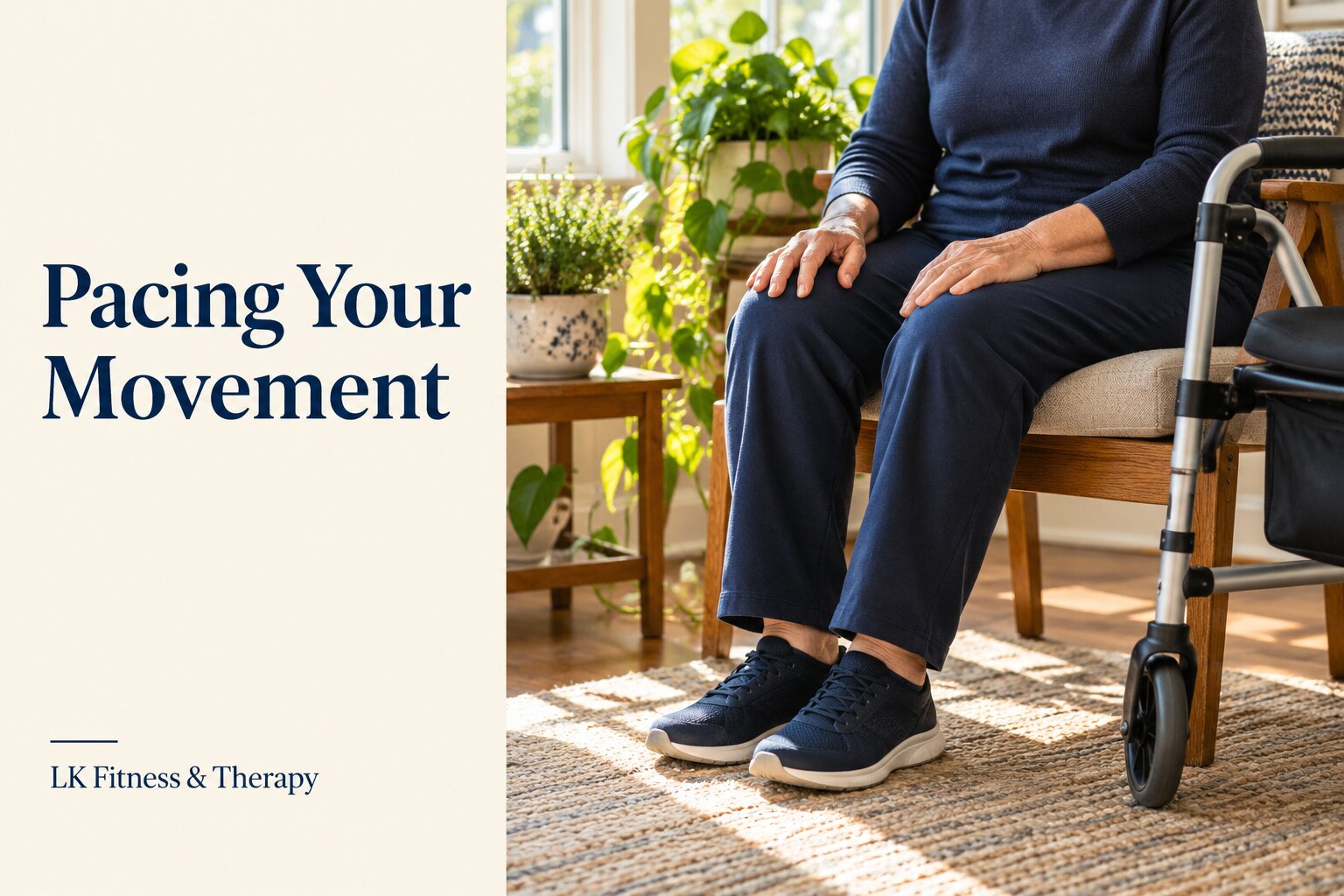
When Fatigue Changes Your Walking: How I Pace Mobility Practice

Illustration of a seated rest break with a walker nearby, titled Pacing Your Movement

You may start a walking task with steady steps and find that it becomes harder to control as you tire. During home physical therapy, I pay attention to those changes so we can choose an appropriate amount of practice.

Ask what fatigue feels like

Tiredness, weakness, dizziness, and feeling generally unwell are different experiences. I ask what has changed and how it affects your daily activity. New or unusual symptoms may require medical assessment before we continue.

Watch the quality of movement

During a visit, I may observe step length, balance, use of support, and how you transfer weight as you walk. If the task becomes harder to control, I can reduce the challenge, provide a rest, or stop and reassess. Completing more steps is not the only measure of a useful session.

Build practice around your abilities

CDC guidance recommends choosing the amount and type of activity that fit a person’s abilities and conditions, with a gradual start when needed. I apply that principle by choosing an individual starting point, rather than a fixed walking distance for everyone. CDC guidance on activity and disability.

Plan for the activities that matter

I ask about the tasks you want to keep doing, such as moving around your home or gardening. We can discuss the setup, support, and rest needed for those activities. Your home plan should explain the amount to practice and how to respond when it becomes difficult.

Do not use a normal reading to dismiss symptoms

Blood pressure and pulse are part of the information considered during care; they do not explain every symptom. NHLBI advises talking with a doctor about symptoms such as chest pain or dizziness during physical activity. If you feel newly unwell, tell your clinician before exercising. NHLBI guidance on activity risks.

Use Client Resources for your assigned Medbridge program. This article is general education and does not establish the cause of fatigue or prescribe a walking routine. Talk with Dr. Lenny about personalized mobility care at home. Call 267-647-9097 or text me about your goals. Related reading: Explore balance and mobility practice at home.

Have a question about this article?

I can help you understand how this information relates to your goals, symptoms and home routine.

Call Dr. Lenny at 267-647-9097 or send me a text to discuss whether one-on-one care at home is a good fit.


Movement Can Be Enjoyable: Balance and Mobility Practice at Home

Illustration of seated ball activity with caregiver support, titled Movement Can Be Enjoyable

Working on mobility does not have to feel like repeating the same drill all visit. During home physical therapy, I may use a simple game or a familiar task to bring variety to practice while keeping the session focused on your goals.

Give each activity a purpose

For someone who enjoys it, a soft-ball activity may provide a way to practice reaching or coordinating movement. For another person, a familiar task such as rising from a chair may be more meaningful. I choose the activity after assessing the person, rather than treating a game as a complete balance program.

Keep support part of the plan

A seated activity, a shorter reach, or a different pace may be the right starting point. Standing activities require an assessment of balance and support needs. I do not ask someone to release their walker to catch a ball unless the setup and their ability make that appropriate.

Build a mix of movement

CDC guidance for older adults includes aerobic activity, muscle strengthening, and balance work, with activity adapted to ability. I use that broad framework while choosing specific practice for your mobility needs and medical precautions. CDC guidance for older adults.

Help caregivers understand the setup

When a caregiver is involved, we can review the chosen exercise, required support, and when to stop. Simple instructions and a familiar routine help everyone understand what has been assigned. A caregiver should follow the plan we reviewed rather than add an unfamiliar standing challenge.

Adjust the pace to the person

I ask about effort and symptoms and adjust the session when a rest or a change of activity is needed. Enjoyment and safety are considered together. The purpose is useful practice that the person understands and wants to participate in.

Explore examples of supervised care, or use Client Resources to open your assigned home program. This article is general education, not instructions to copy a balance activity without assessment. Talk with Dr. Lenny about care at home. Call 267-647-9097 or text me about your goals. Related reading: Read how I adjust walking practice when fatigue changes movement.

Have a question about this article?

I can help you understand how this information relates to your goals, symptoms and home routine.

Call Dr. Lenny at 267-647-9097 or send me a text to discuss whether one-on-one care at home is a good fit.

After a Broken Wrist: Staying Safe and Independent at Home

Editorial image of an older adult resting a splinted wrist on a cushion, titled After a broken wrist.

A broken wrist can change much more than how you use your hand. Getting out of a chair, bathing, carrying a meal and using a stair rail may suddenly need a different approach. When I provide physical therapy at home after a fall, I look at both the injury and the everyday movements that need to be safe during recovery.

Protect the wrist while keeping the rest of you moving

A distal radius fracture is a break near the wrist end of the forearm’s radius bone. Your orthopedic clinician determines when you can move the wrist, lift objects or put weight through the hand. A removable splint does not automatically mean you can take it off for exercise.

Gentle movement of the fingers and other joints not immobilized may be appropriate, following your care team’s instructions. Wrist stretching, gripping exercises and strengthening need to match your stage of healing. Less pain does not, by itself, mean the bone is ready for more load.

I also check how you stand up and move around without pushing through the injured hand. If you need a walking aid, we need to make sure its setup respects your wrist restrictions.

Look at where the fall happened

During a home visit, I can assess the actual doorway, step or walking route that is causing difficulty. Practical changes may include better lighting, clearing obstacles, secure handrails and footwear that fits securely. In the bathroom, properly installed grab bars, suitable seating and temporary assistance may help make daily care safer.

I choose balance and strength work around the person’s ability and fracture precautions. Research supports appropriately designed exercise for reducing falls, including a trial that integrated balance and strength activities into daily routines. That does not mean every balance exercise is safe to try alone.

If dizziness is part of the picture, check the cause

Dizziness can have several causes, including inner-ear disorders, medication effects and other medical conditions. I do not assume that dizziness with head movement establishes a specific vestibular diagnosis.

When vestibular rehabilitation is appropriate, exercises are selected for the assessed problem and adjusted to the person’s response. I would not recommend standing on one leg with eyes closed as a general home exercise after a fall. The plan needs to account for symptoms, available support and the healing wrist.

Recovery also means planning ahead

Keep your orthopedic follow-up appointments and ask when each activity can resume. Seek prompt medical advice for new numbness, pale fingers, worsening pain or difficulty moving the fingers. After a fracture from a fall at standing height, ask your medical clinician whether bone-health assessment is appropriate.

My goal is to help you protect the healing injury while staying as active and independent as safely possible. In-home physical therapy lets us practice the daily tasks that matter in the setting where you actually do them.

For one-on-one physical therapy at home in Bucks County, Montgomery County and Northeast Philadelphia, call 267-647-9097 to discuss your needs.

This article provides general education; your fracture restrictions and exercise plan should come from your treating clinicians.

Related resources

Balance and mobility practice at home
Home exercise access and more movement resources

Sources

AAOS: Distal radius fractures and cast and splint care — orthopedic guidance.

CDC: Fall prevention and NIH/NIDCD: Balance disorders — official guidance.

Clemson et al., BMJ, 2012: The LiFE randomized trial — original research on integrating balance and strength training into daily life in older adults at increased fall risk; not a wrist-fracture rehabilitation trial.

Have a question about this article?

I can help you understand how this information relates to your goals, symptoms and home routine.

Call Dr. Lenny at 267-647-9097 or send me a text to discuss whether one-on-one care at home is a good fit.

Verified by MonsterInsights