
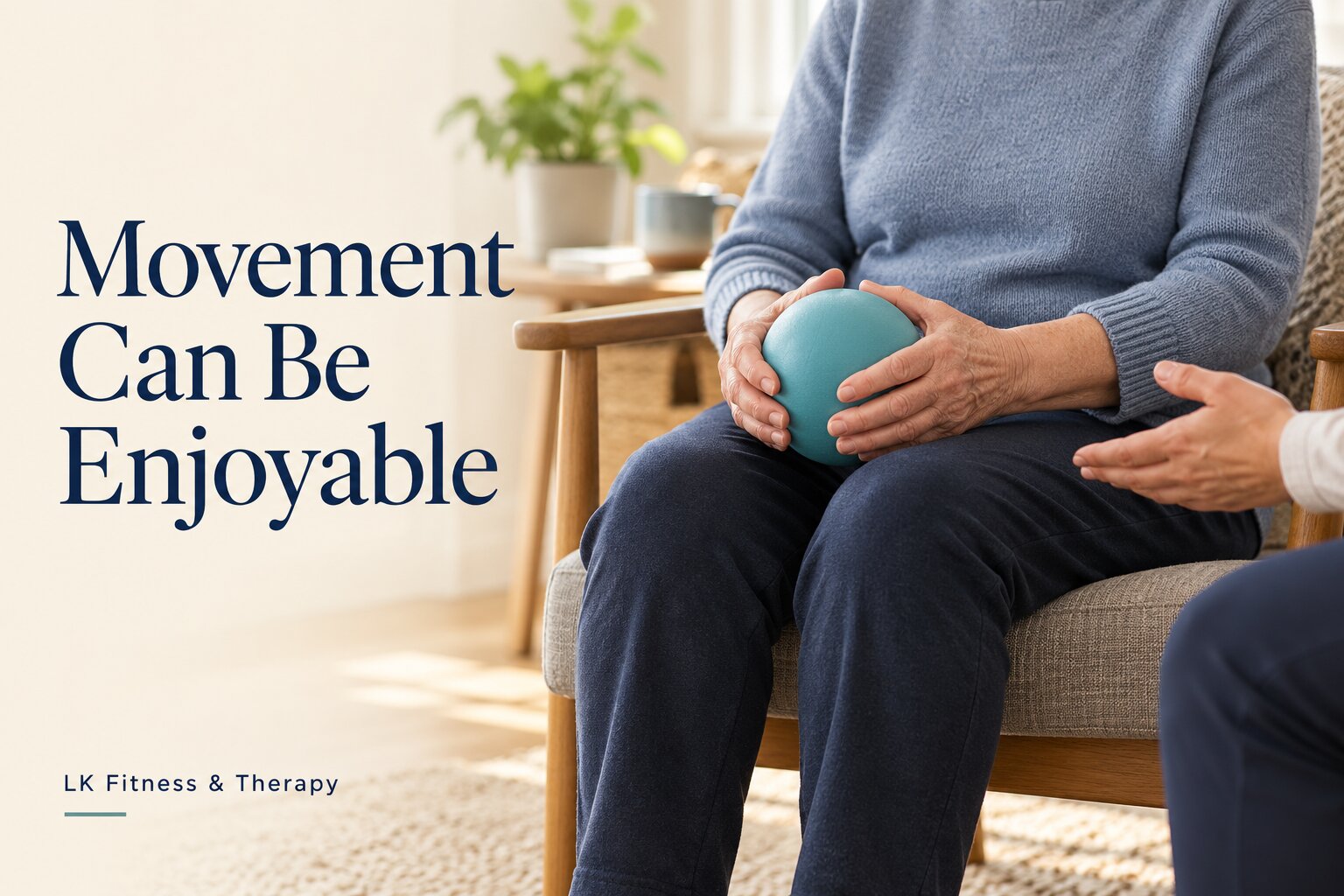
Working on mobility does not have to feel like repeating the same drill all visit. During home physical therapy, I may use a simple game, a familiar task or an activity the person enjoys to create useful practice while keeping the session focused on measurable goals.
Give each activity a purpose
A soft-ball activity might be used to practice reaching, reaction or coordinated movement. For another person, repeated chair rises, stepping to targets or walking to a meaningful destination may be more useful. The activity is selected after assessment rather than treating a game as a complete balance program.
Balance training should be challenging enough—and safe enough
Effective balance exercise usually needs to challenge the systems involved in maintaining stability, but the challenge has to match the person’s fall risk and available support. A seated activity, stable counter, shorter reach or different stance may be the right starting point. I do not remove a person’s walker simply to make an exercise “harder.”
Build a mix of movement
Public-health and fall-prevention guidance supports a combination of aerobic activity, strengthening and balance work, adapted to ability. For people at increased fall risk, well-designed exercise programs can reduce falls. That evidence supports progressive training—not copying an advanced balance drill without assessment.
Help caregivers understand the setup
When a caregiver is involved, we review the chosen exercise, required support, amount of assistance and when to stop. A caregiver should reinforce the plan that was practiced rather than invent a new standing challenge.
Enjoyment can improve the likelihood of practice
An exercise still needs a clinical purpose, but people are more likely to participate in activities they understand and tolerate. I try to make practice relevant enough that it feels like progress toward real life rather than a list of disconnected drills.
Research behind this article
The 2025 APTA Geriatrics clinical practice guideline for physical therapy management of fall risk in community-dwelling older adults supports structured screening, assessment and individualized fall-risk management rather than a one-size-fits-all balance routine. Exercise challenge, support and progression still need to match the individual, particularly when an assistive device or caregiver is involved.
Reference: Kirk-Sanchez N, et al. Physical Therapy Management of Fall Risk in Community-Dwelling Older Adults: An Evidence-Based Clinical Practice Guideline From APTA Geriatrics. J Geriatr Phys Ther. 2025;48(2):62-87.
Explore examples of supervised care or Exercise & Client Tools. This article is general education, not instructions to copy a balance activity without assessment. Call or text Dr. Lenny: 267-647-9097.

2 thoughts on “Movement Can Be Enjoyable: Balance and Mobility Practice at Home”
Comments are closed.