Feeling Stiff? How I Help You Rebuild Movement at Home

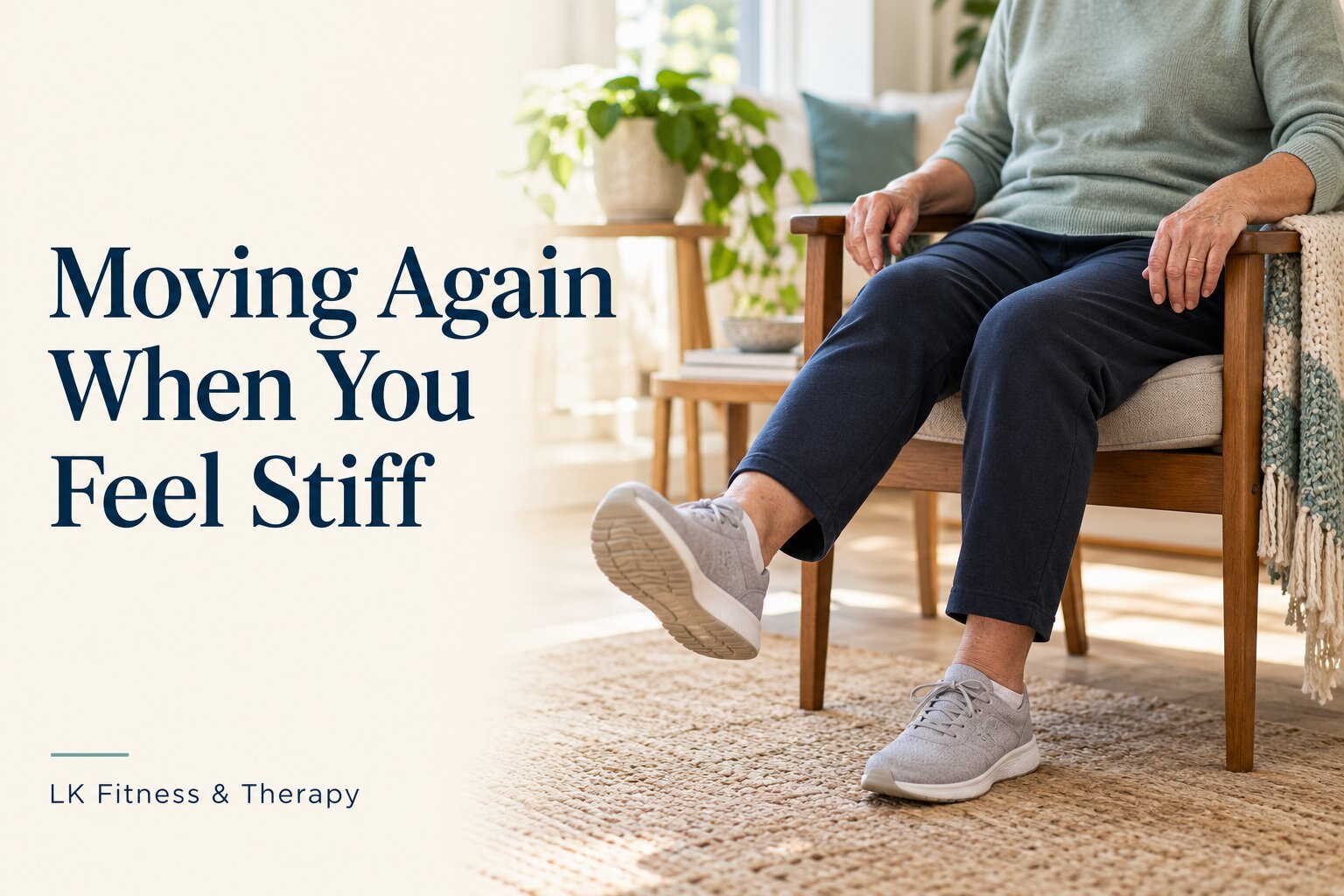
Illustration of supported seated knee movement, titled Moving Again When You Feel Stiff

When a knee feels difficult to bend or your back feels tight, the next step is an assessment of what limits your movement. In a home visit, I look at comfortable positions, how you move, and the everyday activities you want to do more easily.

Stiffness is a description, not a diagnosis

I ask about the onset of the restriction, pain, swelling, recent illness or injury, and any precautions from your medical team. I compare movements and observe whether support or a change of position helps. A restricted movement can have more than one contributor; I do not assume that it is simply tight muscle or fear.

Start with movement you can control

Depending on the assessment, practice may include supported knee bending, gentle active movement, or strengthening within a suitable range. I choose the position, amount of assistance, and challenge for the individual. AAOS recommends discussing exercise selection with your clinician and raising questions when an exercise causes pain. AAOS knee conditioning guidance.

Make room for confidence

If you hesitate or brace during a task, I ask what feels difficult and what concerns you. We may slow the movement, make it smaller, or use support so you can practice with more control. This is part of my approach to the visit; it does not establish the cause of your symptoms or mean that they are imagined.

Connect practice with everyday life

I also assess activities such as rising from a chair, standing comfortably, and walking in your home. Progress is based on your response and goals. If you use a walker, the plan includes how to use it safely; reducing support is an individual decision.

Keep the home plan clear

Your instructions should explain the movement, how much to do, and when to ask for help. I use Medbridge to provide your assigned exercises and demonstrations, available through Client Resources. Tell me about changes in symptoms so we can review the plan.

This article describes my approach and is general education, not an exercise prescription or a patient case report. Call Dr. Lenny at 267-647-9097 or send a text to discuss one-on-one care at home. Related reading: Read how I adjust a home exercise that hurts.

Have a question about this article?

I can help you understand how this information relates to your goals, symptoms and home routine.

Call or text Dr. Lenny: 267-647-9097 to discuss whether one-on-one care at home is a good fit.

Knee Pain When Walking: What I Check First

Editorial image of an older adult walking at home, with the title Knee pain when walking.

If your knee hurts when you walk, the most useful starting point is the task that limits you. Is it the first few steps, a longer walk, stairs, or getting up from a low chair? I use those details to connect the assessment to what you need to do each day.

I check the knee and watch you move

I assess knee movement, strength and swelling, then observe relevant tasks such as walking and rising from a chair. I may also check your hip or back when the history and examination suggest they could be contributing. Knee pain does not have one explanation for everyone.

Seeing you at home lets me assess the chair you actually use, the steps you need to manage and the walking space available for practice.

Exercise is usually broader than one knee exercise

A quad set or seated knee extension may be a useful starting point when more demanding exercise is uncomfortable, but neither is a complete treatment for knee pain. For osteoarthritis and many other nonsurgical knee problems, rehabilitation commonly progresses toward appropriately dosed strengthening, functional exercise and aerobic activity based on tolerance and goals.

That might include controlled chair rises, suitable step practice and manageable walking. The starting level, support and amount depend on your assessment and response.

Some discomfort does not automatically mean damage

Exercise should be tolerable and recoverable. I look at the response during the activity, later that day and afterward rather than treating every temporary increase in symptoms as evidence that exercise is harmful. Increasing swelling, repeated giving way, a major loss of function or a substantial persistent flare is a reason to reassess.

Measure progress in daily life

I want to know whether you can walk farther or more comfortably, get out of a chair more easily, manage stairs better and return to activities that matter to you. Exercise dose can then be progressed rather than remaining permanently at the easiest level.

Know when knee pain needs medical assessment

A suddenly hot, swollen knee with fever, or inability to bear weight after significant injury, needs prompt medical assessment. New major swelling, locking or repeated instability may also warrant further evaluation depending on the situation.

Research behind this article

Clinical guidelines for hip and knee osteoarthritis consistently place individualized education and exercise therapy at the center of nonsurgical management. Evidence supports strengthening and aerobic exercise for improving pain and physical function, while the exact program should be tailored rather than prescribing one exercise to everyone.

I provide one-on-one physical therapy in your home. See my service area and how to get started, or Call or text Dr. Lenny: 267-647-9097 to discuss the activities your knee pain is limiting.

Verified by MonsterInsights