
A Better Workout Starts With the Right Challenge for You

Illustration of seated resistance-band exercise, titled The Right Challenge for You

An exercise can look simple on a screen and feel very different when you try it. During one-on-one fitness and wellness visits, I watch how you perform a movement, listen to your feedback, and adapt the challenge to your starting point.

The exercise name is only the beginning

A movement can be changed by adjusting resistance, speed, range, body position, or support. I may demonstrate it, give a short cue, or choose a different version. The aim is to help you understand and control the task.

Choose a challenge that fits

CDC guidance recognizes that activity intensity depends on fitness, comfort, and health, and recommends choosing activities that fit your abilities. Resistance bands and body-weight movements are among its examples of strengthening activity. That leaves plenty of room to build a useful workout without assuming that jumping or an advanced floor exercise is right for everyone. CDC activity guidance.

Your feedback helps shape the session

Tell me if a movement is confusing, uncomfortable, or harder to control than expected. I can change the setup or pause to review it. A successful visit gives you a clear next step and practice that fits your goals.

Report symptoms during and after exercise

Nausea or vomiting is something to report, not a measure of a good workout. Stop exercising if it occurs, and seek medical advice if it recurs or persists. Vomiting can have several causes; its timing alone does not tell us whether exercise caused it. MedlinePlus advises urgent medical care for severe abdominal pain or difficulty keeping fluids down, and emergency care for blood or coffee-ground material in vomit. MedlinePlus guidance on nausea and vomiting.

Keep practice between visits straightforward

When I assign a home program, I use Medbridge for exercise instructions and videos you can revisit. The GO app also supports reminders and completed-exercise logging. Open your home exercise resources.

This article provides general education and describes my coaching approach. Your workout and any medical precautions should be individualized. Discuss private fitness, wellness, or physical therapy at home with Dr. Lenny. Call 267-647-9097 or send a text. Related reading: See what private fitness at home looks like.

Have a question about this article?

I can help you understand how this information relates to your goals, symptoms and home routine.

Call or text Dr. Lenny: 267-647-9097 to discuss whether one-on-one care at home is a good fit.
Feeling Stiff? How I Help You Rebuild Movement at Home

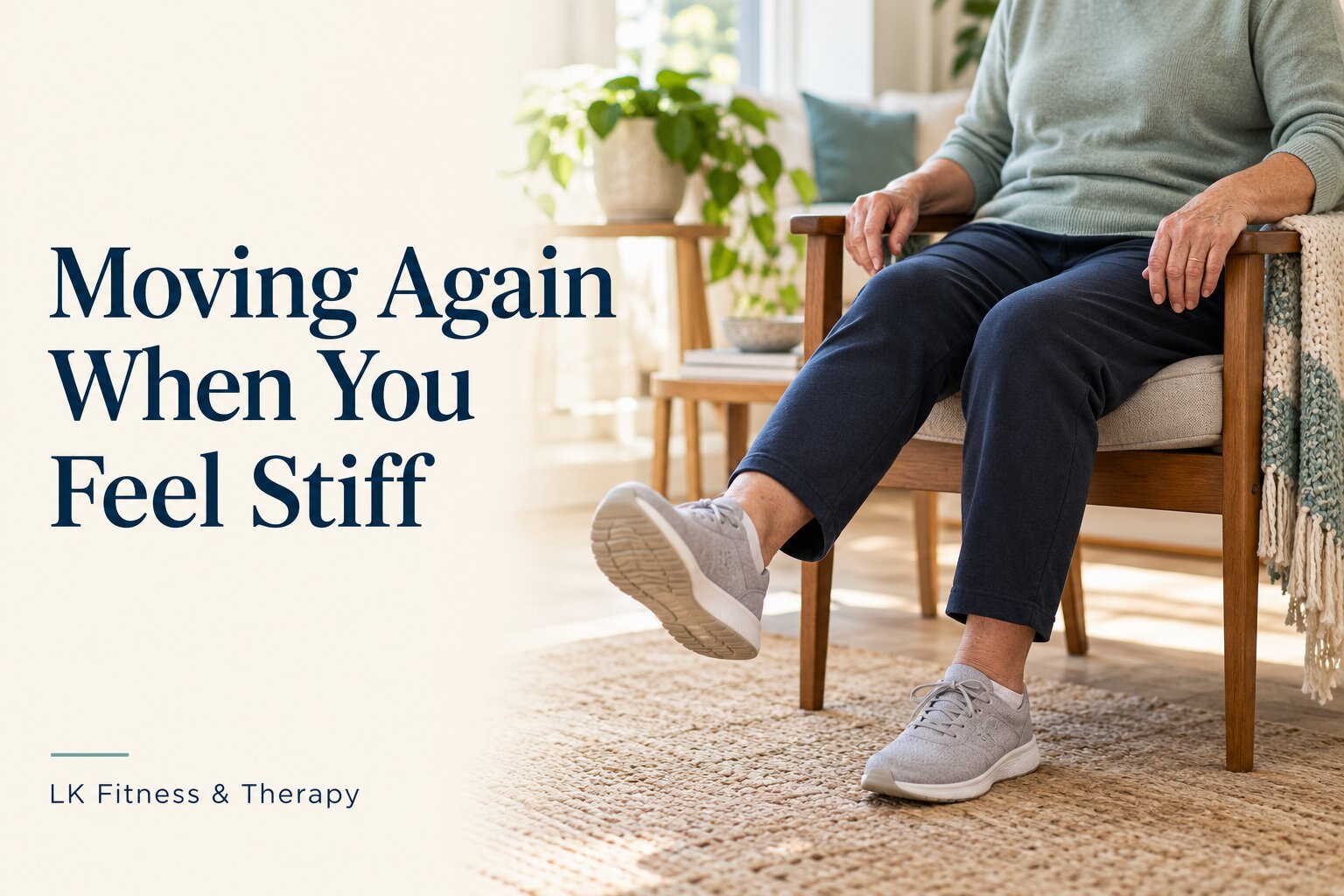
Illustration of supported seated knee movement, titled Moving Again When You Feel Stiff

When a knee feels difficult to bend or your back feels tight, the next step is an assessment of what limits your movement. In a home visit, I look at comfortable positions, how you move, and the everyday activities you want to do more easily.

Stiffness is a description, not a diagnosis

I ask about the onset of the restriction, pain, swelling, recent illness or injury, and any precautions from your medical team. I compare movements and observe whether support or a change of position helps. A restricted movement can have more than one contributor; I do not assume that it is simply tight muscle or fear.

Start with movement you can control

Depending on the assessment, practice may include supported knee bending, gentle active movement, or strengthening within a suitable range. I choose the position, amount of assistance, and challenge for the individual. AAOS recommends discussing exercise selection with your clinician and raising questions when an exercise causes pain. AAOS knee conditioning guidance.

Make room for confidence

If you hesitate or brace during a task, I ask what feels difficult and what concerns you. We may slow the movement, make it smaller, or use support so you can practice with more control. This is part of my approach to the visit; it does not establish the cause of your symptoms or mean that they are imagined.

Connect practice with everyday life

I also assess activities such as rising from a chair, standing comfortably, and walking in your home. Progress is based on your response and goals. If you use a walker, the plan includes how to use it safely; reducing support is an individual decision.

Keep the home plan clear

Your instructions should explain the movement, how much to do, and when to ask for help. I use Medbridge to provide your assigned exercises and demonstrations, available through Client Resources. Tell me about changes in symptoms so we can review the plan.

This article describes my approach and is general education, not an exercise prescription or a patient case report. Call Dr. Lenny at 267-647-9097 or send a text to discuss one-on-one care at home. Related reading: Read how I adjust a home exercise that hurts.

Have a question about this article?

I can help you understand how this information relates to your goals, symptoms and home routine.

Call or text Dr. Lenny: 267-647-9097 to discuss whether one-on-one care at home is a good fit.
After a Broken Wrist: Staying Safe and Independent at Home

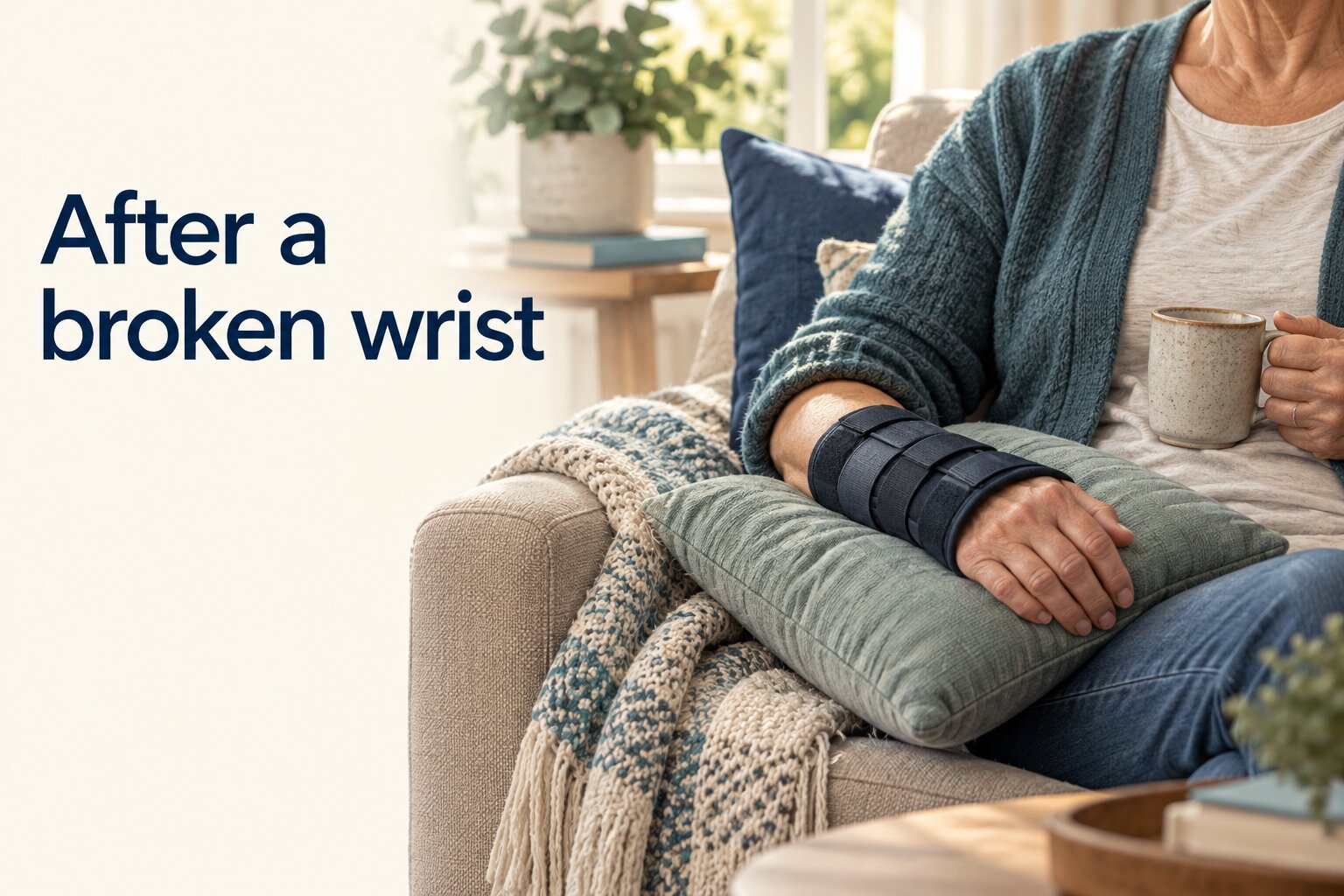
Editorial image of an older adult resting a splinted wrist on a cushion, titled After a broken wrist.

A broken wrist can change much more than how you use your hand. Getting out of a chair, bathing, carrying a meal and using a stair rail may suddenly need a different approach. When I provide physical therapy at home after a fall, I look at both the injury and the everyday movements that need to be safe during recovery.

Protect the wrist while keeping the rest of you moving

A distal radius fracture is a break near the wrist end of the forearm’s radius bone. Your orthopedic clinician determines when you can move the wrist, lift objects or put weight through the hand. A removable splint does not automatically mean you can take it off for exercise.

Gentle movement of the fingers and other joints not immobilized may be appropriate, following your care team’s instructions. Wrist stretching, gripping exercises and strengthening need to match your stage of healing. Less pain does not, by itself, mean the bone is ready for more load.

I also check how you stand up and move around without pushing through the injured hand. If you need a walking aid, we need to make sure its setup respects your wrist restrictions.

Look at where the fall happened

During a home visit, I can assess the actual doorway, step or walking route that is causing difficulty. Practical changes may include better lighting, clearing obstacles, secure handrails and footwear that fits securely. In the bathroom, properly installed grab bars, suitable seating and temporary assistance may help make daily care safer.

I choose balance and strength work around the person’s ability and fracture precautions. Research supports appropriately designed exercise for reducing falls, including a trial that integrated balance and strength activities into daily routines. That does not mean every balance exercise is safe to try alone.

If dizziness is part of the picture, check the cause

Dizziness can have several causes, including inner-ear disorders, medication effects and other medical conditions. I do not assume that dizziness with head movement establishes a specific vestibular diagnosis.

When vestibular rehabilitation is appropriate, exercises are selected for the assessed problem and adjusted to the person’s response. I would not recommend standing on one leg with eyes closed as a general home exercise after a fall. The plan needs to account for symptoms, available support and the healing wrist.

Recovery also means planning ahead

Keep your orthopedic follow-up appointments and ask when each activity can resume. Seek prompt medical advice for new numbness, pale fingers, worsening pain or difficulty moving the fingers. After a fracture from a fall at standing height, ask your medical clinician whether bone-health assessment is appropriate.

My goal is to help you protect the healing injury while staying as active and independent as safely possible. In-home physical therapy lets us practice the daily tasks that matter in the setting where you actually do them.

For one-on-one physical therapy at home in Bucks County, Montgomery County and Northeast Philadelphia, call 267-647-9097 to discuss your needs.

This article provides general education; your fracture restrictions and exercise plan should come from your treating clinicians.

Related resources

Balance and mobility practice at home
Home exercise access and more movement resources

Sources

AAOS: Distal radius fractures and cast and splint care — orthopedic guidance.

CDC: Fall prevention and NIH/NIDCD: Balance disorders — official guidance.

Clemson et al., BMJ, 2012: The LiFE randomized trial — original research on integrating balance and strength training into daily life in older adults at increased fall risk; not a wrist-fracture rehabilitation trial.

Have a question about this article?

I can help you understand how this information relates to your goals, symptoms and home routine.

Call or text Dr. Lenny: 267-647-9097 to discuss whether one-on-one care at home is a good fit.

Glute Spasms After Activity: How I Balance Hip Strength and Recovery

Editorial image of an older adult resting in an armchair after activity, titled Strength and recovery.

When someone tells me their glutes tighten or spasm after a demanding day, I want to know what happened before, during, and after the activity. Was it a heavier workout, extra yard work, or several busy days in a row? That pattern helps me adjust the plan.

My goal is to build the strength you need for everyday movement while giving you enough recovery to tolerate the next session.

A spasm is a symptom, not a diagnosis

A tight or spasming buttock muscle can have more than one explanation. Muscle fatigue or protective tightening may contribute, but the symptom alone does not prove that you overtrained, injured a muscle, or have a particular hip or back problem. I assess the movement, your symptom history, and any other findings before deciding what to change.

Recovery days can still include movement

I often separate harder strengthening sessions from easier practice. Depending on the exercise load and your response, a lighter day between demanding hip workouts may be useful. That does not mean everyone needs the same every-other-day schedule.

Comfortable walking and gentle mobility work may fit on lighter days. I choose the amount with you and check whether it leaves symptoms settled. Stretching is optional; I do not ask you to force a stretch or keep walking through increasing spasms.

How I progress hip exercises

Depending on the assessment, a program might include hip movements, side steps, supported lunges, or step-ups. These are examples of exercises I use, not a routine everyone with buttock pain should start.

I look for a manageable effort, steady control, and a response that allows you to keep doing your usual activities. More repetitions or a deeper lunge can show progress, but I also care about how you feel later that day and the next morning.

When an exercise is going well, I usually change one thing at a time—repetitions, resistance, depth, or support. If symptoms flare, we can reduce the dose or use an easier version. Advanced single-leg work can wait until the current task is manageable.

What I want you to tell me

  • Which activity brings on the tightness or spasms?
  • How long do symptoms last, and do they affect walking or sleep?
  • What happens later that day and the next morning?
  • Does a lighter session help, or are symptoms becoming more frequent?

New or worsening weakness, numbness, or pain traveling down the leg needs assessment rather than simply changing a workout. Seek urgent medical care for new bladder or bowel control problems or numbness around the groin or saddle area.

A plan that fits your day

Work, household tasks, and exercise all add to the day’s activity. I account for that when we plan strengthening and recovery. If your program keeps provoking symptoms, tell me so we can adjust it. You can also contact me about an individual assessment.

General education from Dr. Leonid “Lenny” Klichinsky, PT, DPT. Exercise selection and progression should be individualized. Background reference: ACSM position stand on resistance-training progression (healthy adults; it does not establish a treatment for glute spasms).

Have a question about this article?

I can help you understand how this information relates to your goals, symptoms and home routine.

Call Dr. Lenny at 267-647-9097 or send me a text to discuss whether one-on-one care at home is a good fit.

When a Home Exercise Hurts: Let’s Adjust It

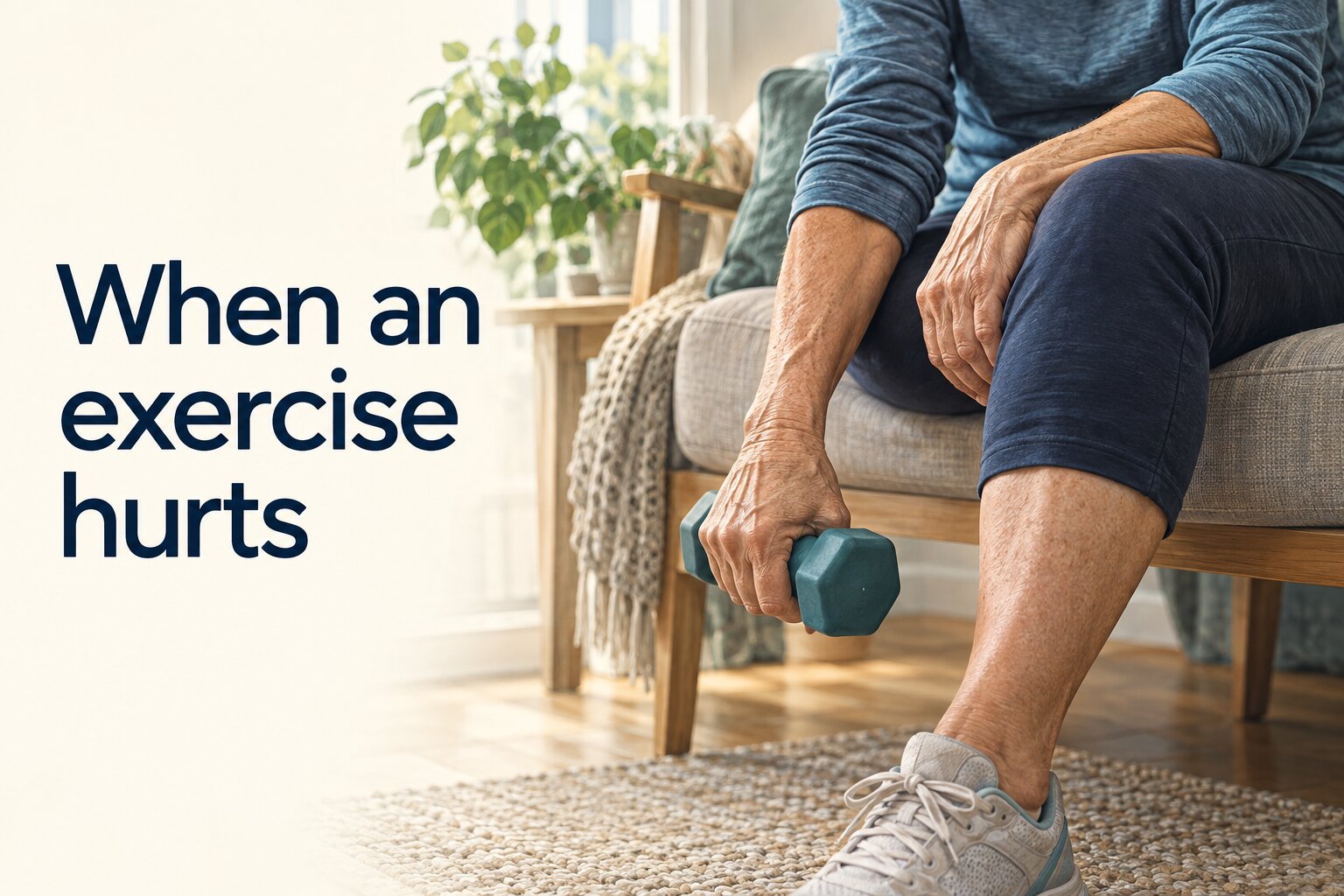
Editorial image of an older adult pausing a seated dumbbell exercise, titled When an exercise hurts.

If an exercise in your home program bothers another joint, tell me. That is useful feedback. The plan should address the problem we are treating while accounting for the rest of your body.

Show me the exact exercise

For example, a prone press-up used in some back programs places weight through the hands and arms. If your back feels better but your elbow or wrist hurts, I need to reassess the exercise and its setup.

A prone press-up and a strengthening push-up can look similar, but their purposes differ. Show me the movement rather than relying only on its name. Tell me where the discomfort starts, which part of the movement brings it on, and whether it lingers afterward.

Change the plan with a clear goal

After reassessing, I may change the support, range, repetitions or exercise itself. I then check whether the adjustment still helps with the intended problem and is manageable for your other joints.

For a back exercise, that means checking the back and leg response as well as the discomfort in your arm. For a strengthening exercise, I look at the movement, effort and symptoms before deciding how to progress it.

Your feedback helps me make it workable

Tell me which exercises you completed, which you skipped, and what happened later. We can review your actual chair, floor space or equipment during a home visit. That is more useful than a program that looks good on paper but is difficult to carry out.

Do not repeatedly push through sharp, increasing or lingering joint pain. Contact me to review the exercise. Sudden severe pain, substantial swelling or loss of function needs prompt medical assessment.

Call me at 267-647-9097 to discuss physical therapy and a home program suited to your needs.

Related advice

Knee pain when walking: what I check
How I assess centralization and back pain
Browse my physical therapy and movement articles

This article describes my clinical approach to adjusting an individual exercise program. Illustration for general education.

Knee Pain When Walking: What I Check First

Editorial image of an older adult walking at home, with the title Knee pain when walking.

If your knee hurts when you walk, the most useful starting point is the task that limits you. Is it the first few steps, a longer walk, stairs, or getting up from a low chair? I use those details to connect the assessment to what you need to do each day.

I check the knee and watch you move

I assess knee movement, strength and swelling, then observe relevant tasks such as walking and rising from a chair. I may also check your hip or back when the history and examination suggest they could be contributing. Knee pain does not have one explanation for everyone.

Seeing you at home lets me assess the chair you actually use, the steps you need to manage and the walking space available for practice.

Exercise is usually broader than one knee exercise

A quad set or seated knee extension may be a useful starting point when more demanding exercise is uncomfortable, but neither is a complete treatment for knee pain. For osteoarthritis and many other nonsurgical knee problems, rehabilitation commonly progresses toward appropriately dosed strengthening, functional exercise and aerobic activity based on tolerance and goals.

That might include controlled chair rises, suitable step practice and manageable walking. The starting level, support and amount depend on your assessment and response.

Some discomfort does not automatically mean damage

Exercise should be tolerable and recoverable. I look at the response during the activity, later that day and afterward rather than treating every temporary increase in symptoms as evidence that exercise is harmful. Increasing swelling, repeated giving way, a major loss of function or a substantial persistent flare is a reason to reassess.

Measure progress in daily life

I want to know whether you can walk farther or more comfortably, get out of a chair more easily, manage stairs better and return to activities that matter to you. Exercise dose can then be progressed rather than remaining permanently at the easiest level.

Know when knee pain needs medical assessment

A suddenly hot, swollen knee with fever, or inability to bear weight after significant injury, needs prompt medical assessment. New major swelling, locking or repeated instability may also warrant further evaluation depending on the situation.

Research behind this article

Clinical guidelines for hip and knee osteoarthritis consistently place individualized education and exercise therapy at the center of nonsurgical management. Evidence supports strengthening and aerobic exercise for improving pain and physical function, while the exact program should be tailored rather than prescribing one exercise to everyone.

I provide one-on-one physical therapy in your home. See my service area and how to get started, or Call or text Dr. Lenny: 267-647-9097 to discuss the activities your knee pain is limiting.

Back Pain After Yoga: How I Adjust the Plan

Editorial image of an adult resting on a chair beside a yoga mat and blocks, titled Back pain after yoga.

If your back hurts after yoga, I want to know which positions you used and how you felt during and after class. Even a gentle or restorative class can include a bend, twist or long hold that does not suit you that day.

Start with the movement that bothered you

Was it a forward bend, a twist, holding a position, or getting up from the floor? Did pain begin during class, later that evening, or the next morning? Did it stay in your back or spread into your buttock or leg? Those details give me a better starting point than the class name alone.

A flare-up does not tell us exactly which tissue is involved or mean that bending and twisting must be avoided permanently. I assess your movement and symptom response before recommending changes.

Adjust the position and reassess

Depending on what I find, we may reduce the movement range, shorten a hold, add support, or temporarily leave out a position that consistently aggravates symptoms. I change the plan, then check how you respond.

A lumbar roll may make sitting more comfortable for some people, but comfort in one position is only part of the picture. I also want to know whether you can walk, sit and sleep more comfortably afterward.

Keep the goal practical

The aim is to return to an activity you enjoy with a plan you can manage. Tell me about delayed symptoms too. An exercise that feels fine during a session may still need adjusting if you are consistently worse later.

Persistent or worsening pain that repeatedly interrupts sleep needs medical assessment. Seek urgent care for new bladder or bowel changes, numbness around the groin, or significant new leg weakness.

I come to you for one-on-one, private-pay physical therapy in Ivyland, Warminster and nearby towns. See my service area and how to get started, or call me at 267-647-9097 to discuss your goals, current pricing and visit availability.

Related advice

Centralization and the McKenzie Method
How I adapt a home exercise that hurts
Browse my physical therapy and movement articles

Research: Saper and colleagues (2017) studied a structured yoga program for chronic low back pain. Its findings do not mean every pose in a general class is suitable for every person. The modifications described here are part of an individual clinical assessment.

Centralization and Back Pain: How I Use the McKenzie Method

Editorial image of an adult seated at home with a hand resting on the lower back, titled Centralization and back pain.

When I assess back pain, I ask where you feel it as well as how much it hurts. A change in the location of symptoms can help me decide which movements to use in treatment.

What centralization means

Imagine you have pain in your low back and calf. After a particular movement, the calf pain eases or disappears, and symptoms are felt closer to the back. That retreat of symptoms toward the spine is called centralization. This is an example, not a description of a particular patient.

Simply feeling less pain, or noticing pain closer to the middle of your back, does not by itself establish this pattern. I compare your symptoms before and after movement and check whether the change lasts.

How I use that information

The McKenzie Method, also called Mechanical Diagnosis and Therapy, uses an assessment of how symptoms and movement respond to different positions and repeated movements. It is more than a set of back-extension exercises.

If extension repeatedly helps during your assessment, it may become part of your home program. Someone else may respond better to a different direction, or need another approach. I also look at whether sitting, standing and walking become easier.

Centralization is a useful treatment clue. It does not prove that a disc has moved back into place or identify the exact tissue causing pain. My aim is to find a manageable starting point, then build your movement and activity as your response allows.

What the evidence tells us

Research supports checking for centralization and directional preference because these responses can provide useful information about prognosis and help guide an individualized movement plan. They do not occur in everyone with back pain, and they should not be interpreted as proof that one exercise direction or one treatment method is best for every person.

Evidence also depends on the population being studied. Research in people with chronic low back pain who demonstrate a directional preference has found benefit from McKenzie-based care, while a Cochrane review of people with acute or subacute nonspecific low back pain did not find the McKenzie Method to be an effective stand-alone treatment approach for that broader group. That is one reason I use the examination response to guide treatment rather than prescribing extension exercises simply because someone has back pain.

What to tell me between visits

Tell me where your symptoms are before and after your prescribed exercises, whether relief lasts, and what happens later that day. New or increasing symptoms farther down the leg are a reason to contact me and review the plan. Do not repeatedly force an exercise that worsens your symptoms.

Seek urgent medical care for new bladder or bowel changes, numbness around the groin, or significant new leg weakness.

I provide one-on-one physical therapy in your home. Call or text Dr. Lenny: 267-647-9097 to discuss your back pain and daily goals.

Related advice

Back pain after yoga: how I adjust the plan
When a home exercise hurts: let’s adjust it
Browse my physical therapy and movement articles

Research behind this article

Key sources include May, Runge & Aina (2018), a systematic review of centralization and directional preference; George and colleagues (2021), the JOSPT clinical practice guideline for acute and chronic low back pain; Almeida and colleagues (2023), a Cochrane review of the McKenzie Method for acute/subacute nonspecific low back pain; and Hennemann and colleagues (2025), a systematic review and meta-analysis of McKenzie care delivered by credentialed therapists for chronic low back pain with directional preference. Evidence evolves, and treatment should be matched to the individual examination and response.

General education; exercises should follow an individual assessment.

Have a question about this article?

I can help you understand how this information relates to your goals, symptoms and home routine.

Call or text Dr. Lenny: 267-647-9097 to discuss whether one-on-one care at home is a good fit.
In-Home Personal Training & Fitness Near Warminster | Dr. Lenny

Editorial image of an older adult and trainer beside a chair at home, titled Fitness at home.

Looking for in-home personal training near Ivyland or Warminster? I’m Dr. Leonid “Lenny” Klichinsky, PT, DPT. I bring one-on-one personal training, fitness and wellness sessions to your home, with plans built around your goals, your space and how you move in daily life. I also offer mobile outpatient physical therapy as a separate service when assessment or treatment is needed.

A session built around you

Some people want to build strength and endurance. Others want to move with more confidence, improve flexibility, or keep making progress after physical therapy. We talk about what matters to you, look at your current movement and surroundings, and choose exercises that fit your space and routine. I bring equipment for the visit. When appropriate, a session can include guided, hands-on stretching.

Fitness and physical therapy are different starting points

You do not have to finish physical therapy before beginning private fitness or wellness. If you need assessment and treatment for an injury, pain, or a medical condition, we can discuss whether physical therapy is the right service. Fitness and general wellness are private-pay services. Physical therapy payment options depend on your coverage and the care you need.

Why the home setting can help

Your plan can use the rooms, stairs, and everyday movements that are already part of your life. There is no trip to a clinic or gym, and your visit stays focused on you. My goal is to make the work practical, encouraging, and worth continuing between sessions.

Start close to home

I’m based in Ivyland, near Warminster, and prioritize nearby visits in Richboro, Southampton, Holland, Hatboro, Feasterville, and surrounding communities. Availability depends on your address and schedule.

If private fitness, wellness, or physical therapy at home sounds useful, call me at 267-647-9097 to discuss your goals and the right visit option. You can also learn more about private fitness & wellness care.

Verified by MonsterInsights